
Kimi K3 vs Open AI GPT 5.6 SOL: Comparison
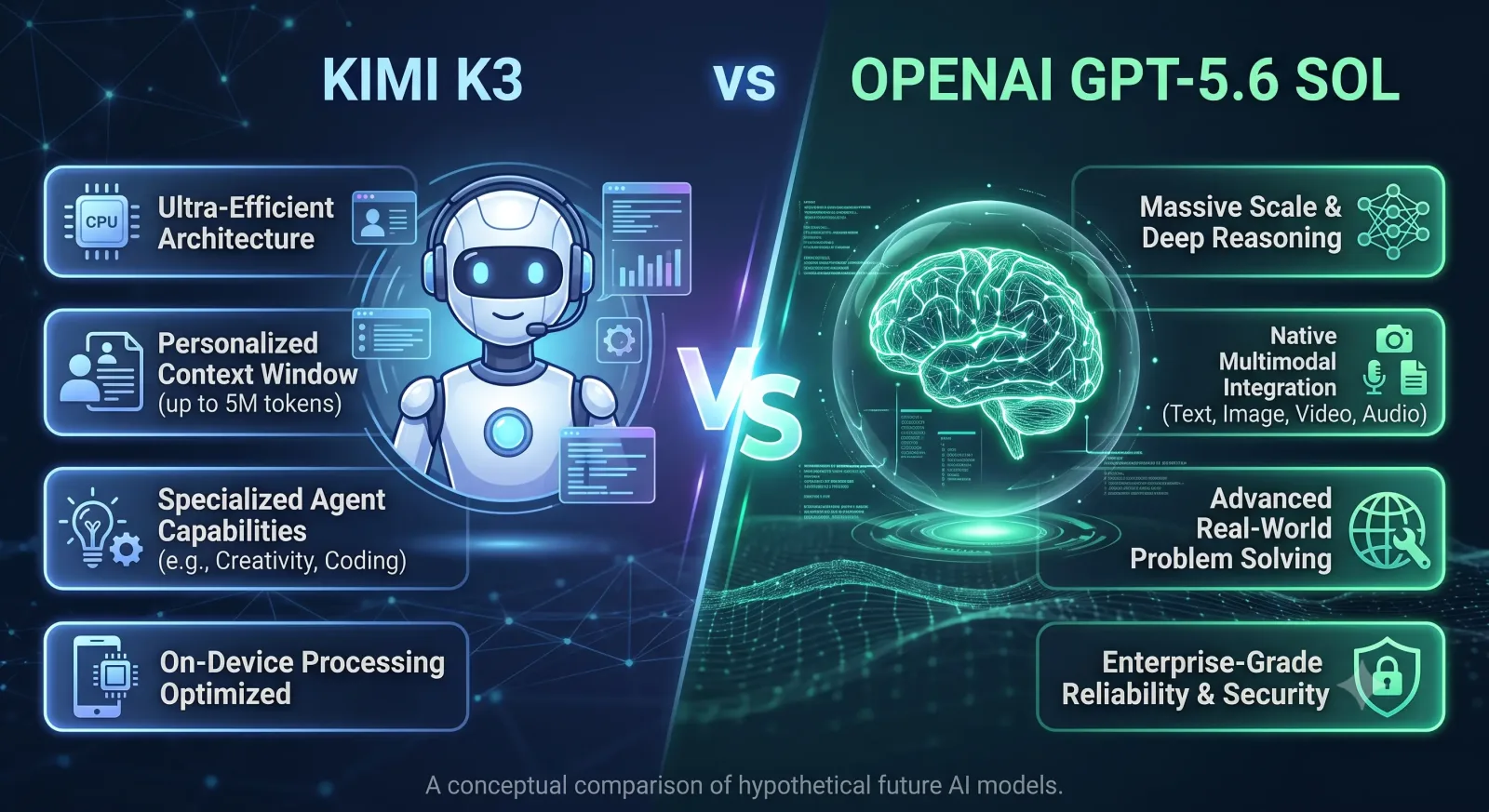
KIMI K3 vs OpenAI GPT‑5.6 Sol: The 2026 AI Showdown
Published: July 19, 2026 • Reading time: 12 min
In July 2026, the AI world witnessed two seismic releases within days of each other. On one side, Chinese startup Moonshot AI unveiled Kimi K3 — the world's largest open‑weight AI model at 2.8 trillion parameters. On the other, OpenAI launched its flagship GPT‑5.6 Sol, the crown jewel of a three‑tier model family. This article delivers a comprehensive, technical, and unbiased comparison of these two frontier AI systems.
1. Kimi K3: The Open‑Source Giant
On July 16, 2026, Moonshot AI (月之暗面) introduced Kimi K3, a model that immediately disrupted the global AI landscape. It is the first open‑weight model to approach the 3‑trillion‑parameter mark, making it the largest publicly accessible AI system ever released.
Technical Specifications
- Total Parameters: 2.8 trillion
- Architecture: Sparse Mixture‑of‑Experts (MoE) with 896 experts, activating only 16 per token during inference.
- Context Window: 1 million tokens — capable of processing entire codebases or lengthy research papers in a single pass.
- Native Vision: Built‑in multimodal understanding for images and video.
-
Key Innovations:
- Kimi Delta Attention (KDA): A hybrid linear attention mechanism delivering up to 6.3× faster decoding in million‑token contexts.
- Attention Residuals (AttnRes): Improves training efficiency by ~25% at under 2% extra cost.
- Stable LatentMoE: Further sparsifies the MoE architecture.
- Open‑Source Release: Full model weights will be publicly available on July 27, 2026.
Moonshot claims K3 achieves roughly 2.5× better scaling efficiency than its predecessor, Kimi K2. The model is already accessible via Kimi chatbot, Kimi Work, Kimi Code, and API.
Official resources: Kimi official website • Moonshot AI
2. OpenAI GPT‑5.6: The Three‑Tier Flagship
On July 9, 2026, OpenAI rolled out the GPT‑5.6 family to general availability. The series adopts a celestial naming scheme — Sol, Terra, and Luna — reflecting a strategic product segmentation from frontier performance to cost efficiency.
Model Lineup
| Model | Positioning | Primary Use Cases | Input Price (per 1M tokens) | Output Price (per 1M tokens) |
|---|---|---|---|---|
| GPT‑5.6 Sol | Frontier flagship | Coding, research, cybersecurity, science, long‑horizon reasoning | $5.00 | $30.00 |
| GPT‑5.6 Terra | Enterprise workhorse | Balanced cost/intelligence, daily workflows | $2.50 | $15.00 |
| GPT‑5.6 Luna | Cost‑effective | High‑volume, repeatable tasks | $1.00 | $6.00 |
Source: OpenAI official pricing
Key Capabilities
- Reasoning efficiency: GPT‑5.6 Sol sets a new high of 53.6 on Agents' Last Exam, eclipsing Claude Fable 5 by 13.1 points.
- Cybersecurity: OpenAI's “most robust safety stack to date” with enhanced protections for sensitive requests.
- ARC‑AGI‑3: First model to win a public game (ft09, 87%).
- Multi‑agent orchestration: Supports spinning up subagents for parallel, focused work.
- Integration: Available in ChatGPT, Codex, OpenAI API, GitHub Copilot, and Microsoft 365 Copilot.
Official resources: OpenAI • GPT‑5.6 official page
3. Head‑to‑Head: Kimi K3 vs GPT‑5.6 Sol
3.1 Benchmark Performance
Independent evaluations paint a picture of intense competition, with Kimi K3 trading blows with GPT‑5.6 Sol across multiple benchmarks.
| Benchmark | Kimi K3 | GPT‑5.6 Sol | Claude Fable 5 | Details |
|---|---|---|---|---|
| Program Bench | 77.8 | 77.6 | 76.8 | Kimi K3 narrowly edges out both rivals |
| Terminal Bench 2.1 | 88.3 | 88.8 | 84.6 | Very close second to GPT‑5.6 Sol |
| DeepSWE | 69% | 73% | 70% | Kimi K3 is first open‑weight model at this level |
| SWE Marathon | 42.0 | 39 | 35 | Kimi K3 leads |
| BrowseComp | 91.2 | — | — | Kimi K3 leads |
| Frontend Code Arena | 1st place | 2nd | 3rd | First time a Chinese model beats US rivals in blind human preference |
| Artificial Analysis Index | 57 | 59 | 60 | Kimi K3 ranks #3 globally |
Sources: Digital Trends, AI Today, KuCoin
3.2 GPU Kernel Optimization
Moonshot claims Kimi K3 “performed competitively with Fable 5 (with fallback) and substantially outperformed GPT‑5.6 Sol, and GPT‑5.5” in GPU kernel optimization.
3.3 Reasoning & Agentic Capabilities
While GPT‑5.6 Sol maintains an edge in overall performance, Kimi K3 demonstrates surprising strength in specific agentic tasks. Moonshot acknowledges that Kimi K3 still trails GPT‑5.6 Sol and Claude Fable 5 on overall performance, but it consistently outperforms Claude Opus 4.8 and GPT‑5.5.
3.4 Real‑World Applications
Moonshot showcased Kimi K3's ability to autonomously optimize GPU kernels, build a GPU compiler from scratch, design chips for AI models, and complete complex research tasks — including reproducing a computational astrophysics study in ~2 hours that would typically take a senior researcher 1–2 weeks.
4. Pricing & Cost Efficiency
4.1 API Pricing Comparison
| Model | Input (per 1M tokens) | Output (per 1M tokens) | Cost per Task (standardized) |
|---|---|---|---|
| Kimi K3 | $3.00 | $15.00 | $0.94 |
| GPT‑5.6 Sol | $5.00 | $30.00 | $1.04 |
| GPT‑5.6 Terra | $2.50 | $15.00 | — |
| GPT‑5.6 Luna | $1.00 | $6.00 | — |
| Claude Fable 5 | $10.00 | $50.00 | $2.75 |
| Claude Opus 4.8 | $5.00 | $25.00 | $1.80 |
Sources: Digital Trends, WaveSpeed, Simon Willison, KuCoin
4.2 Cost Analysis
- Kimi K3 is ~9% cheaper per task than GPT‑5.6 Sol ($0.94 vs $1.04).
- Kimi K3 costs roughly half of Claude Opus 4.8 ($0.94 vs $1.80).
- GPT‑5.6 Luna is the lowest‑cost option at $1.00 input / $6.00 output per 1M tokens.
- Kimi K3's pricing represents a departure from the ultra‑low‑cost strategy of earlier Chinese models. Its API charges 100 yuan ($14.7) per million output tokens, compared with 6 yuan for DeepSeek V4‑Pro.
Morgan Stanley analysts noted that Kimi K3's premium pricing strategy could have a far‑reaching positive impact on China's LLM market, steering the industry toward more sustainable business models while narrowing the pricing gap with US models.
5. Open‑Source vs Proprietary: The Strategic Divide
5.1 Kimi K3: Open‑Weight Revolution
- World's first open model in the 3‑trillion‑parameter class — developers can download, run locally, modify, and fine‑tune.
- Full weights due July 27, 2026 — a watershed moment for open‑source AI.
- Democratizes access to frontier AI capabilities, though running it locally requires significant computing resources.
- Represents a direct challenge to Silicon Valley's commercial models.
5.2 GPT‑5.6 Sol: Closed‑Source Excellence
- Proprietary system accessible only via API and OpenAI's platforms.
- Most robust safety stack to date, with enhanced protections for sensitive cybersecurity requests.
- Deep integration with Microsoft ecosystem (GitHub Copilot, Microsoft 365 Copilot).
- Subject to US government oversight — OpenAI's release was initially throttled due to national security considerations.
5.3 Geopolitical Context
The launch of Kimi K3 comes at a highly sensitive moment. Just weeks earlier, the US government temporarily forced Anthropic to withdraw its flagship Fable and Mythos models due to severe cybersecurity concerns. Washington now views advanced AI software as critical national infrastructure subject to strict export controls.
Kimi K3's rapid emergence suggests Chinese firms are successfully bypassing these regulatory barriers and advancing independently despite US restrictions on hardware sales.
The BBC noted that this breakthrough “upends long‑held assumptions in the West that Chinese developers trail their American peers”. The Financial Times analyzed that Kimi K3's launch may upend the industry consensus that Chinese frontier AI models lag US counterparts by 8–12 months.
Market impact: Shares of Moonshot's domestic competitors Zhipu AI and MiniMax tumbled sharply in Hong Kong by about 27% and 16% respectively following the announcement.
6. The Verdict: Which Model Wins?
Kimi K3 — Strengths
- ✅ Largest open‑weight model ever released (2.8T parameters).
- ✅ 1M token context window — unparalleled for long‑horizon tasks.
- ✅ Beats GPT‑5.6 Sol on Program Bench, SWE Marathon, BrowseComp, and Frontend Code Arena.
- ✅ ~9% cheaper per task than GPT‑5.6 Sol.
- ✅ Open‑source — fosters innovation, transparency, and customization.
- ✅ Native vision and multimodal understanding.
GPT‑5.6 Sol — Strengths
- ✅ Overall performance lead — still the benchmark for frontier intelligence.
- ✅ Superior on DeepSWE (73% vs 69%) and Terminal Bench 2.1 (88.8 vs 88.3).
- ✅ Three‑tier product line (Sol/Terra/Luna) covers all use cases and budgets.
- ✅ Enterprise‑ready — integrated with GitHub Copilot, Microsoft 365, and robust safety features.
- ✅ Proven track record — ARC‑AGI‑3 win, cybersecurity benchmarks.
The Bottom Line
Kimi K3 is not yet a complete GPT‑5.6 Sol killer. OpenAI's flagship retains the overall performance crown, particularly in complex software engineering (DeepSWE) and enterprise‑grade reasoning. However, Kimi K3 represents a monumental leap for open‑source AI — it is the first time an open‑weight model has traded blows with the world's best proprietary systems on multiple benchmarks, at a lower cost, with full transparency and customization.
As the BBC put it: “The sudden breakthrough suggests that China's tech prowess is rapidly narrowing the capabilities gap”. Whether you are a developer seeking open‑source freedom, an enterprise prioritizing safety and integration, or a researcher pushing the boundaries of AI, both models represent the absolute cutting edge — and the competition between them will only accelerate innovation for everyone.
7. Further Reading
- Kimi K3 official announcement blog — Moonshot AI
- GPT‑5.6 official page — OpenAI
- Digital Trends: New open‑weight AI from China is toppling the best of OpenAI and Claude Fable
- BBC: China's Moonshot AI claims Kimi K3 can rival OpenAI and Anthropic
- CNBC: Chinese AI has leveled up
- Simon Willison: The new GPT‑5.6 family — Luna, Terra, Sol
- OpenAI API Pricing