
Kimi K3 vs Deepseek V4
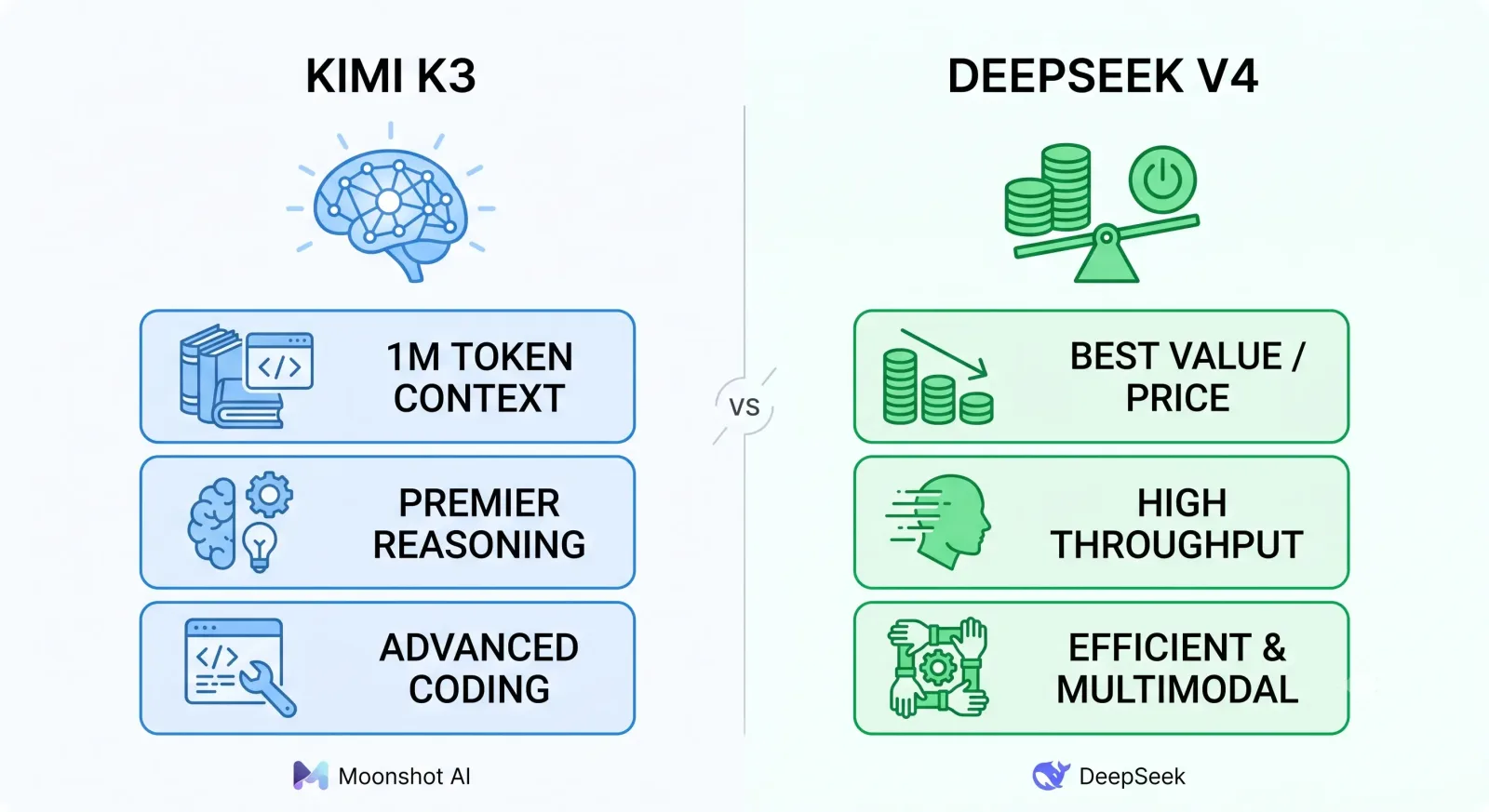
Kimi K3 vs DeepSeek V4: The Ultimate Open-Weight AI Model Comparison (2026)
Kimi K3 and DeepSeek V4 are two of the most capable open-weight large language models (LLMs) released in 2026. Both are designed for frontier-level reasoning, coding, agentic workflows, and enterprise AI applications, but they take different approaches to licensing, multimodal capabilities, pricing, and deployment.
This article compares Kimi K3 and DeepSeek V4 using official documentation and independent benchmark providers to help developers, businesses, and AI enthusiasts choose the right model.
Kimi K3 vs DeepSeek V4 Overview
Moonshot AI introduced Kimi K3 in July 2026 as a next-generation open-weight Mixture-of-Experts (MoE) model focused on long-horizon reasoning, software engineering, multimodal understanding, and autonomous agent tasks. Official documentation describes it as a 2.8 trillion parameter model with a 1 million-token context window and native image understanding.
DeepSeek released DeepSeek V4 in April 2026 as the successor to the V3 family. It remains one of the strongest open-weight reasoning models, emphasizing cost efficiency, enterprise deployment, mathematical reasoning, and software development. Official model listings confirm V4 as DeepSeek's latest flagship model.
Architecture
| Specification | Kimi K3 | DeepSeek V4 |
|---|---|---|
| Release | July 2026 | April 2026 |
| Architecture | Mixture of Experts (MoE) | Mixture of Experts (MoE) |
| Total Parameters | 2.8 Trillion | Approximately 1.6 Trillion (V4 Pro) |
| Context Window | 1 Million Tokens | Up to 1 Million Tokens |
| Vision Support | Yes (Native) | No (Text-only) |
| Open Weights | Yes | Yes |
Key Features
Kimi K3
- 2.8 trillion parameter MoE architecture
- Native multimodal image understanding
- 1 million token context window
- KDA (Kimi Delta Attention) architecture
- Designed for long-running autonomous agents
- Excellent large repository analysis
- Strong kernel optimization and systems programming capabilities
DeepSeek V4
- Open-weight reasoning model
- Enterprise-friendly deployment
- Very low inference costs
- Excellent mathematics performance
- Strong coding capabilities
- Fully permissive MIT licensing
Independent Benchmark Performance
According to Artificial Analysis, Kimi K3 currently scores substantially higher than DeepSeek V3.2 (Reasoning) on its Intelligence Index (57 vs 32), though direct third-party comparisons with DeepSeek V4 are still limited because K3 was only recently released.
Official Kimi documentation also reports leading performance on coding and agent benchmarks, although these vendor-published numbers should be interpreted alongside independent evaluations.
Coding Performance
Both models target professional software engineering, but their focus differs.
- Kimi K3 specializes in long-horizon coding, GPU compiler optimization, chip design, large repositories, and autonomous engineering workflows.
- DeepSeek V4 excels at general software engineering, algorithm implementation, debugging, and cost-efficient production inference.
If your workflow includes very large codebases or multimodal inputs such as screenshots and diagrams, Kimi K3 currently offers an advantage through native vision support and its extremely large context window.
Pricing
DeepSeek V4 generally offers one of the lowest API prices among frontier-class models, making it attractive for large-scale deployments. Kimi K3 is priced higher but offers native vision capabilities, longer-context reasoning, and stronger overall benchmark performance according to early independent evaluations.
Licensing
Both models publish open weights, but their licenses differ.
- DeepSeek V4 uses the MIT license, making it highly permissive for commercial deployment.
- Kimi K3 uses a Modified MIT license with additional branding requirements for very large-scale deployments.
Organizations planning commercial self-hosting should review each license before deployment.
Kimi K3 vs DeepSeek V4 Comparison
| Category | Winner |
|---|---|
| Largest Model | Kimi K3 |
| Vision Support | Kimi K3 |
| Licensing | DeepSeek V4 |
| API Cost | DeepSeek V4 |
| Long Context | Tie |
| Coding | Very Close |
| Research | Tie |
Pros and Cons
Kimi K3 Pros
- Largest open-weight AI model released to date
- Native multimodal support
- Excellent long-context reasoning
- Strong autonomous coding performance
DeepSeek V4 Pros
- Very inexpensive API pricing
- MIT license
- Excellent reasoning performance
- Efficient enterprise deployment
Final Verdict
If your priority is maximum capability, multimodal reasoning, very large context windows, and advanced software engineering, Kimi K3 is currently one of the strongest open-weight AI models available.
If licensing flexibility, deployment cost, and enterprise-scale inference are more important, DeepSeek V4 remains one of the best choices available.
For many development teams, these models are complementary rather than direct replacements—Kimi K3 pushes the frontier of capability, while DeepSeek V4 emphasizes affordability and production readiness.