
Kimi K3 Demonstrates China's Rapid Rise in the Global AI Race
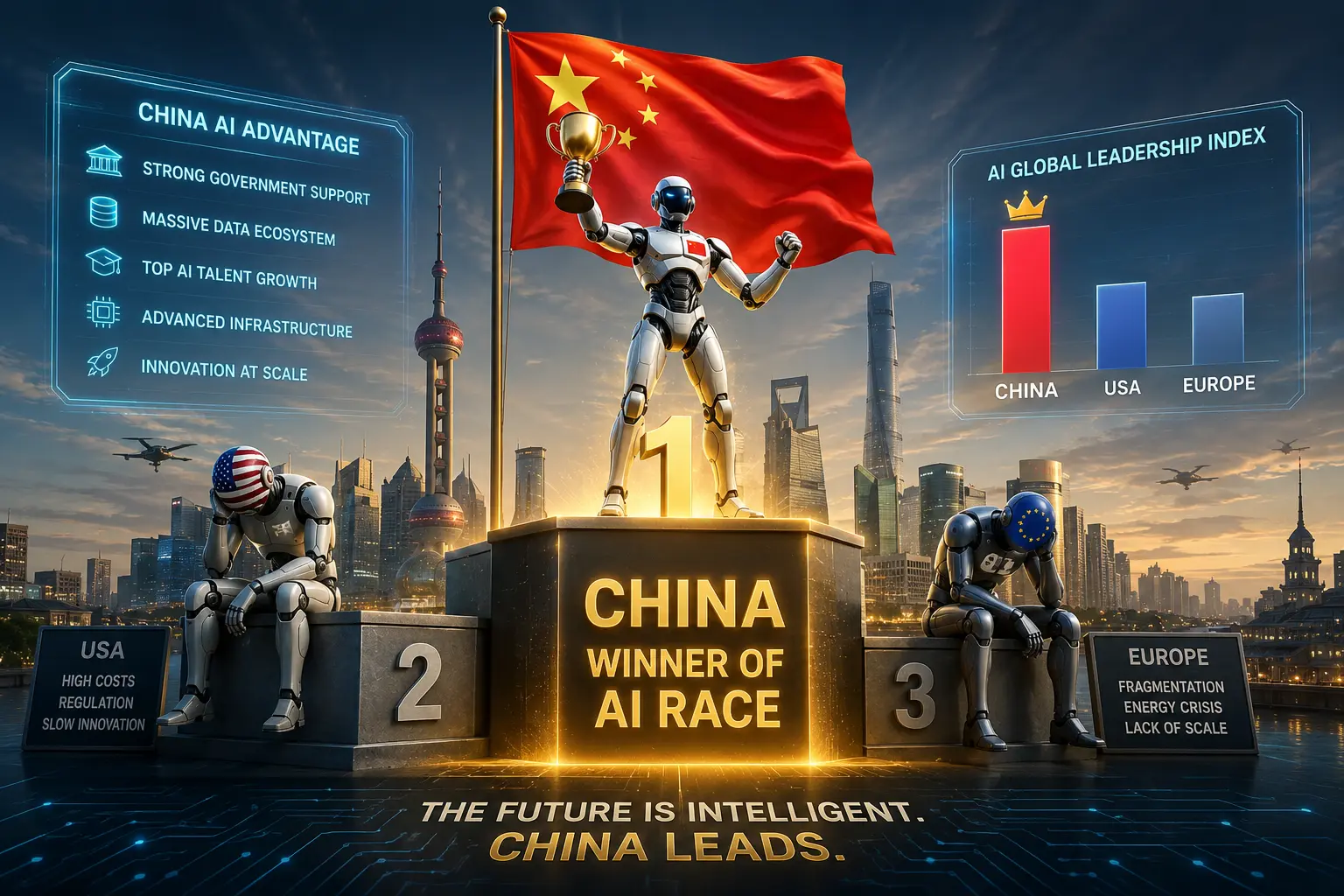
Kimi K3 Demonstrates China's Rapid Rise in the Global AI Race
Published: • Reading time: 8 min
Artificial intelligence has become one of the defining technologies of the 21st century. Countries are investing hundreds of billions of dollars into AI research, semiconductor manufacturing, cloud infrastructure, talent development, and commercial deployment. For several years, the United States appeared to have an overwhelming lead, with companies such as OpenAI, Google DeepMind, Anthropic, Meta, and xAI producing many of the world's most capable frontier models.
However, the global AI landscape has changed dramatically. China is no longer merely following global AI trends—it is actively shaping them. The emergence of advanced models such as DeepSeek, Qwen, GLM, MiniMax, ERNIE, and most recently Kimi K3 demonstrates that Chinese AI companies have become serious competitors at the highest level of artificial intelligence research.
Kimi K3 does not prove that China has already won the AI race. No single model can establish such a conclusion. Instead, it demonstrates something arguably more important: China now possesses the technical expertise, engineering talent, computing infrastructure, and competitive ecosystem required to consistently develop frontier AI systems that rival the world's best.
The AI Race Is No Longer a One-Country Competition
Only a few years ago, discussions about advanced AI focused almost entirely on American research laboratories.
- OpenAI introduced GPT models that transformed conversational AI.
- Google DeepMind continued its pioneering work in machine learning.
- Anthropic became known for highly capable reasoning models.
- Meta accelerated open-weight AI through the Llama family.
These organizations established the perception that frontier AI was largely an American domain.
Today, that perception is changing rapidly.
Chinese companies are producing increasingly capable models across nearly every category:
- General-purpose language models
- Coding assistants
- Multimodal AI
- Long-context reasoning
- Scientific research assistants
- Enterprise AI systems
Rather than competing years behind the leaders, many Chinese models now compete within months of the latest international releases.
Kimi K3 represents one of the strongest examples of this shift. Learn more about Kimi K3.
Kimi K3 Represents the Maturity of China's AI Industry
Every AI release generates excitement, but not every release changes industry perception.
Kimi K3 attracted attention because it reflects years of investment rather than a single breakthrough.
Developing frontier language models requires expertise across multiple disciplines:
- Distributed computing
- Reinforcement learning
- Massive dataset preparation
- Infrastructure engineering
- Optimization algorithms
- Model alignment
- Inference efficiency
- Software engineering
No organization can build a competitive frontier model without mastering these areas simultaneously.
The existence of Kimi K3 therefore signals that China's AI ecosystem has matured considerably.
It is no longer dependent on importing ideas from elsewhere. Instead, Chinese companies are contributing original research, engineering improvements, and deployment strategies.
China Has Built an Entire AI Ecosystem
One of the strongest indicators of technological leadership is not the success of one company but the strength of the surrounding ecosystem.
China now has numerous organizations actively developing advanced AI.
Examples include:
- Moonshot AI (Kimi)
- DeepSeek
- Alibaba (Qwen)
- Zhipu AI (GLM)
- MiniMax
- Baidu (ERNIE)
- Tencent
- Huawei
- ByteDance
Each organization focuses on different areas, creating healthy domestic competition.
- Some emphasize enterprise deployment.
- Others prioritize coding.
- Some focus on multimodal reasoning.
- Others build AI assistants for consumers.
This diversity accelerates innovation because companies continuously compete to improve performance while reducing cost.
Healthy competition often produces better technology than monopoly.
The Importance of Competition
History repeatedly demonstrates that innovation accelerates when multiple organizations compete.
The smartphone revolution benefited from Apple, Samsung, Huawei, Xiaomi, and Google pushing each other forward.
Cloud computing advanced because AWS, Microsoft Azure, and Google Cloud competed aggressively.
The same principle applies to artificial intelligence.
Instead of relying on one dominant company, China now has multiple organizations attempting to outperform each other.
Kimi K3 is therefore not an isolated success.
It is part of an ecosystem where competition continuously drives rapid improvement.
Open Models Have Changed the Rules
One reason Chinese AI companies have gained global attention is their willingness to embrace more open approaches.
Many developers prefer models that can be:
- Downloaded
- Fine-tuned
- Customized
- Self-hosted
- Integrated into enterprise software
Open-weight models encourage community innovation.
- Researchers identify weaknesses.
- Developers build better tools.
- Universities conduct experiments.
- Businesses deploy customized solutions.
This creates a positive feedback loop.
Rather than waiting for a single company to improve a model, thousands of developers contribute to the surrounding ecosystem.
Kimi K3 benefits from this broader movement toward greater accessibility. Moonshot AI official website.
Cost Matters Just as Much as Intelligence
The AI race is not determined solely by benchmark scores.
Businesses evaluate AI using several practical questions:
- How much does inference cost?
- Can it scale?
- Is latency acceptable?
- Can it run efficiently?
- Is deployment practical?
A model that costs dramatically less while delivering comparable performance may ultimately achieve greater adoption.
Chinese AI companies have increasingly focused on inference efficiency and lower operating costs.
This strategy makes advanced AI accessible to startups, researchers, and enterprises that cannot afford premium proprietary services.
Affordability may become one of China's strongest competitive advantages over the next decade.
AI Leadership Requires More Than One Great Model
Some discussions simplify the AI race into benchmark rankings.
In reality, technological leadership depends upon numerous interconnected factors.
These include:
- Research – Publishing new algorithms.
- Talent – Educating engineers and researchers.
- Infrastructure – Building massive GPU clusters.
- Manufacturing – Producing advanced hardware.
- Commercialization – Turning research into products.
- Developer Adoption – Creating ecosystems around APIs and open models.
- Enterprise Integration – Helping businesses deploy AI successfully.
Kimi K3 contributes to several of these dimensions, but true leadership depends on continued progress across all of them.
China's Scale Creates Unique Advantages
China possesses several structural advantages.
Large Engineering Workforce
China graduates enormous numbers of engineers every year. This provides AI companies with access to highly skilled technical talent.
Massive Domestic Market
Hundreds of millions of users create opportunities for rapid product testing. Companies receive extensive real-world feedback. Models improve faster.
Strong Industrial Base
Artificial intelligence increasingly integrates with manufacturing, logistics, robotics, finance, healthcare, and education. China's industrial scale enables AI deployment across diverse sectors.
Long-Term Investment
Government initiatives and private investment continue funding AI infrastructure, research, and education. These investments may produce benefits over many years.
Challenges Still Remain
Despite impressive progress, significant challenges remain.
The United States continues to hold important advantages in several areas.
These include:
- Advanced semiconductor design
- Cutting-edge AI chips
- Global cloud infrastructure
- Venture capital
- Frontier research laboratories
- International software ecosystems
Export restrictions on advanced GPUs have also complicated access to some high-end hardware for Chinese companies.
As a result, China's AI progress has occurred despite notable constraints.
Some observers argue that these constraints have encouraged greater efficiency and innovation.
The AI Race Is Becoming Multipolar
Instead of one clear winner, the AI industry increasingly resembles a multipolar ecosystem.
Major contributors include:
- United States
- China
- Europe
- South Korea
- Japan
- Middle East
Each region contributes unique strengths.
- American companies remain leaders in many frontier research areas.
- Chinese companies increasingly excel in rapid deployment, cost optimization, and large-scale commercialization.
Healthy international competition benefits the broader AI ecosystem.
Read more: CNBC report on China's AI rise.
Why Kimi K3 Matters
Kimi K3 represents more than another chatbot.
It symbolizes the progress of an entire national innovation ecosystem.
Its development reflects:
- Advanced research capability
- Sophisticated engineering
- Competitive infrastructure
- Growing developer communities
- Mature AI organizations
Perhaps most importantly, Kimi K3 changes perceptions.
A few years ago, many observers viewed frontier AI as almost exclusively American.
Today, discussions increasingly include Chinese models alongside GPT, Claude, Gemini, and Llama.
That shift alone demonstrates how rapidly the industry has evolved.
For a deeper dive, see Digital Trends analysis.
Looking Ahead
Artificial intelligence is still in its early stages.
- Reasoning models continue improving.
- AI agents are becoming increasingly capable.
- Robotics is beginning to integrate with language models.
- Scientific discovery may increasingly depend upon AI systems.
The companies and countries that succeed will likely be those capable of continuous innovation rather than occasional breakthroughs.
Kimi K3 suggests that China intends to remain one of those leaders.
Whether future leadership belongs to the United States, China, or a combination of multiple regions will depend on continued research, infrastructure investment, semiconductor innovation, and responsible deployment.
One thing is already clear:
The global AI race is far more competitive today than it was only a few years ago.
Final Verdict
Kimi K3 should not be interpreted as proof that China has already won the global AI race. Such a conclusion would overlook the many dimensions of AI leadership, including semiconductor technology, cloud infrastructure, foundational research, software ecosystems, and commercial adoption.
However, Kimi K3 does demonstrate something highly significant. It shows that Chinese AI companies have reached the frontier of large language model development and are capable of competing with leading international laboratories. Combined with China's rapidly expanding AI ecosystem, growing talent pool, strong industrial base, and focus on efficient deployment, models like Kimi K3 indicate that China has become one of the world's foremost AI powers.
The future of artificial intelligence is unlikely to be defined by a single winner. Instead, it will be shaped by sustained innovation, global competition, and the ability to transform cutting-edge research into real-world applications. In that context, Kimi K3 stands as an important milestone—not because it settles the AI race, but because it confirms that China is now one of its strongest contenders.